
The Hidden Language of Your Health
Most people track a few familiar numbers: steps, hours slept, maybe weight. But once you have decades of records behind you, the more useful question is often not “What happened today?” It is “What has been changing over time?”
That is where a longer view matters.
Why the Right Numbers Matter
Health data becomes more useful when it is reviewed as a pattern instead of a one-time snapshot. A single result can be easy to overread or underread. A trend across months or years is usually easier to review. That is the core idea behind longitudinal health records. Seeing ten years of data in one place changes what you notice.
That is especially true when data is split across:
- hospital portals
- specialist portals
- lab systems
- wearable apps
- printed reports
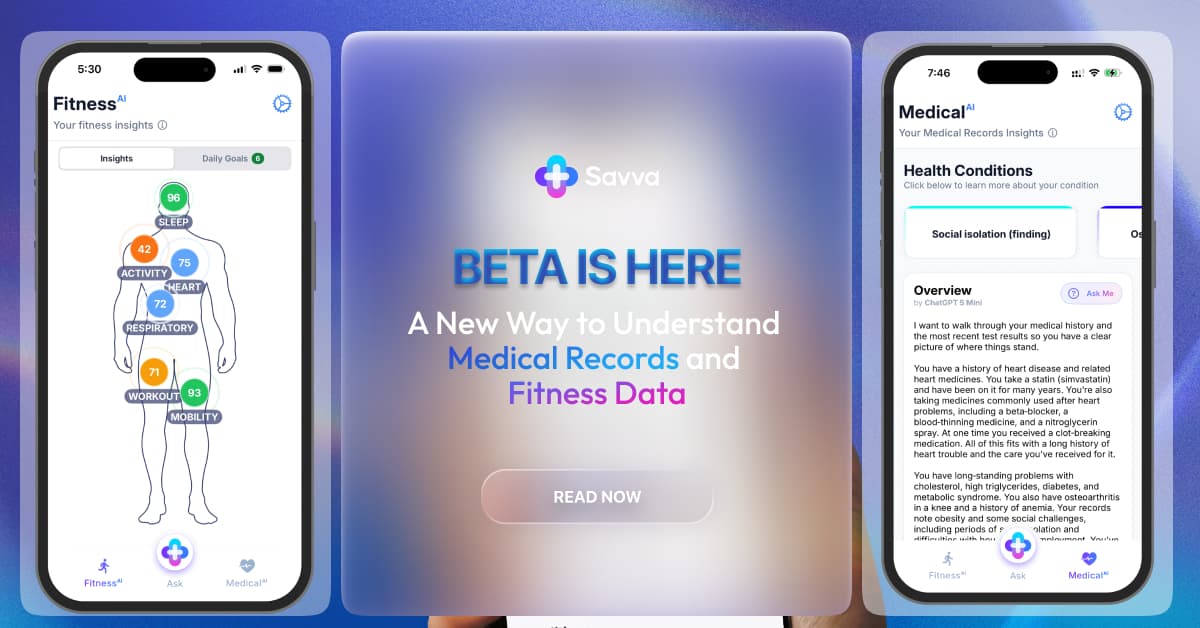
A record review workflow helps when health records, lab history, and wearable data are kept together and organized into readable summaries and fitness insights.
10 Numbers People Often Review After 40
- Heart Rate Variability (HRV)
Often reviewed as a recovery and stress-related fitness trend. - Resting Heart Rate (RHR)
Useful to compare across sleep, travel, and training cycles. - Gait Speed
A simple mobility measure that becomes more useful when reviewed over time. - Double Support Time
A walking metric that appears in mobility-related records across providers. - Blood Oxygen Trends (SpO₂)
More useful as a repeated trend than a single isolated reading. - HbA1c History
Often reviewed across multiple lab dates so the full bloodwork history is easier to follow. - Ferritin
A common lab value that often appears in records alongside fatigue-related follow-up testing and broader bloodwork history. - Triglyceride-to-HDL Ratio
One of several lipid-related values people review next to other routine labs. - VO₂ Max
Often used as a fitness trend for endurance and conditioning. - REM Sleep Duration
Useful when reviewed alongside total sleep, activity, and routine changes.
Rarely Talked About, But Still Useful to Review
Some numbers do not get much attention in everyday conversation, but people still ask about them when organizing their records:
These are not the sort of values most people remember offhand, which is exactly why record organization matters.
How to Organize the Numbers
Instead of looking through several sites and PDFs, it helps to keep records, lab history, and wearable trends in one place. That makes it easier to:
- review the same number across several dates
- keep related results together
- review records alongside routine, sleep, and activity trends
- scan summary-style views before appointments
What You Can Do Now
- Ask for copies of repeat lab results, not just the latest one
- Keep wearable data available next to the rest of your records
- Review trends across months instead of reacting to one isolated value
- Save questions for follow-up appointments in the same place as your reports
- Use a records dashboard that helps you organize both medical summaries and fitness insights
Final Word
The goal is not to watch every number all the time. It is to keep the right records organized so the patterns are easier to review when you need them.
That is where a unified dashboard can be useful. A single organized view can make the long view easier to review.
FAQs
Q1: What is the most useful number to review after 40?
There is rarely one number that matters most for everyone. The more useful approach is to review trends and compare the same value over time.
Q2: Should I focus on wearables or lab results?
Both can be useful. Wearables help with day-to-day fitness trends, while lab results provide a longer medical record. The combination is often more useful than either alone.
Q3: Why does trend history matter so much?
Trend history makes it easier to review whether something has stayed stable, shifted gradually, or changed after a medication, illness, or major life event.
Q4: What kind of setup makes these numbers easier to review?
A setup that keeps records, lab history, and wearable trends together in one organized view makes long-term patterns easier to review.
Q5: Is this only for people with health issues?
No. Many people simply want a clearer, more organized way to keep track of long-term health data.