
Your biomarkers are the closest thing you have to an honest read on your own health. Not how you feel. Not what your scale says today. Your blood pressure, your HbA1C, your fasting glucose, your lipid panel, your kidney markers, your liver enzymes. The numbers your doctor actually checks before deciding anything. The numbers that move months before symptoms do. The numbers that catch the slow drift between visits.
Tracking them well is the difference between knowing where you actually stand and waiting for a problem to show up. Most people understand this. Most people still do not track their biomarkers, because tracking them is broken in every direction.
Why most people do not track their biomarkers
It is not because they do not care. It is because the work has been impossible to do well. Your blood pressure lives in a home cuff app. Your last HbA1C is in a six-year-old visit summary. Your weight is in your scale. Your SpO2 is on your watch. Your glucose, if you check it, is somewhere else entirely.
Pulling all of that together by hand is a project most people will never start. So the data exists, scattered, and the picture nobody can see is the picture of your health.
What other apps miss
Each category of app you might use solves a piece of the problem and stops there.
Fitness apps track activity, sleep, and heart rate. They do not pull labs. They do not show you a blood pressure trend across years. They are about today.
Patient portals carry your labs and your visit history, but each one only shows you the records from that one provider. Switch doctors and your timeline starts over. See a specialist and that lab lives somewhere your primary doctor cannot see.
Single-purpose trackers do one thing well. A glucose app. A blood pressure app. A weight app. Each one is a silo, and your real health is in the relationships between the silos.
Most generalist health apps surface a few wearable readings but stop short of bringing in your full medical record. They show you the data they own, not the data your doctor owns.
The gap is the same in every direction. No app brings your labs, your home readings, your wearable data, and your medical history into one timeline. Until that picture exists, you cannot read your own health honestly.
How Savva fills the gap
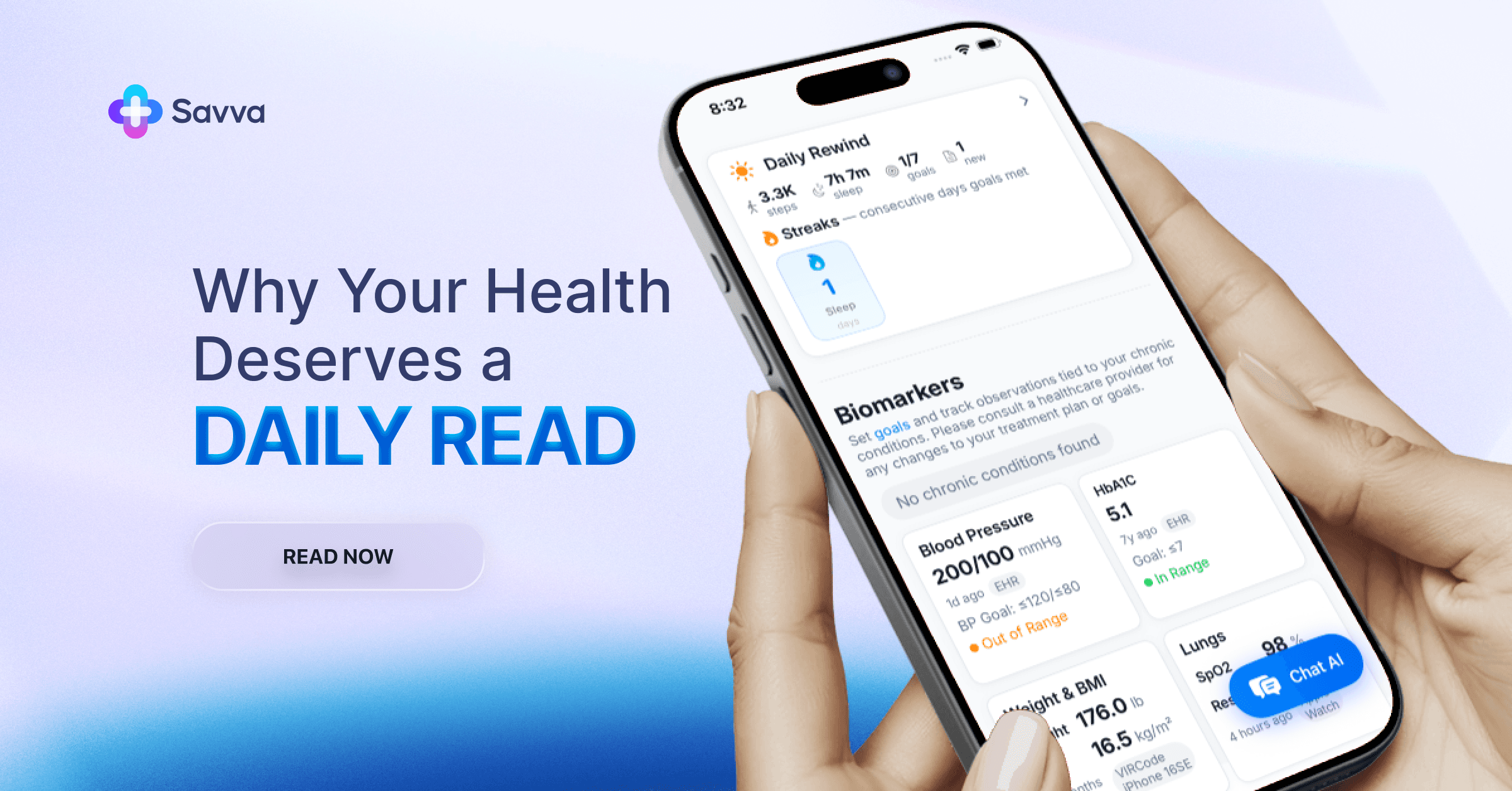
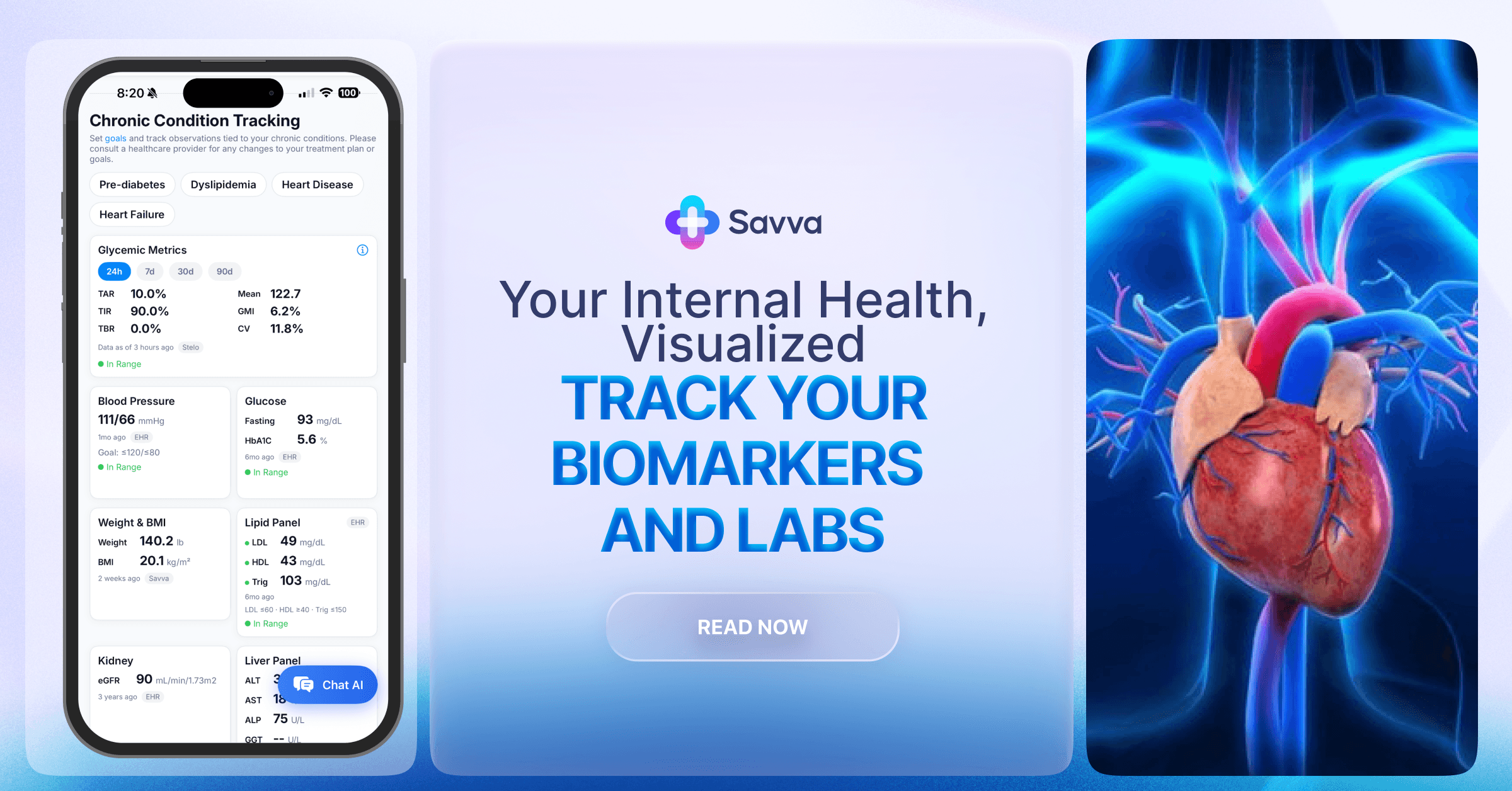
Savva is the layer that sits across all of those sources and assembles them into one view. Five biomarker cards on the home screen, each carrying the most recent reading and the source it came from. EHR. Manual Entry. Apple Watch. Savva.
Each card is honest about how stale the reading is. A blood pressure from three weeks ago. An HbA1C from six years ago. A weight from yesterday. If your record has gaps, the gaps are visible. The point is to make your data readable as it actually is.
Blood Pressure, with the AHA protocol built in
The difference between a blood pressure reading taken right and one taken wrong can change a treatment decision. Most home apps just record the number. Savva builds the AHA's home monitoring protocol into the experience: the rest period, the arm position, the two readings, the timer.
The chart that follows is where it gets interesting. Your home cuff readings sit on the same line as every reading your doctor ever pulled in clinic. Systolic and diastolic plotted as separate lines. EHR data and manual entries layered together. The patterns become visible across years, not just visits.
HbA1C and Glucose, on one timeline
A 110 mg/dL glucose reading after lunch and a 110 mg/dL reading after twelve hours of fasting are two completely different signals. Savva preserves the fasting context with every entry, so the chart you look at later means what you actually think it means.
Your HbA1C readings from your patient portal sit on the same timeline. Whether your doctor has pulled it once in six years or every quarter, the chart shows the trend across 90 days, 1 year, or your full lifetime of readings. The long-term marker and the daily reading, finally on the same screen.
For more on what HbA1C tells you that any single reading cannot, see my A1C trend: good news or bad news?.
Weight & BMI, with your scale and your record
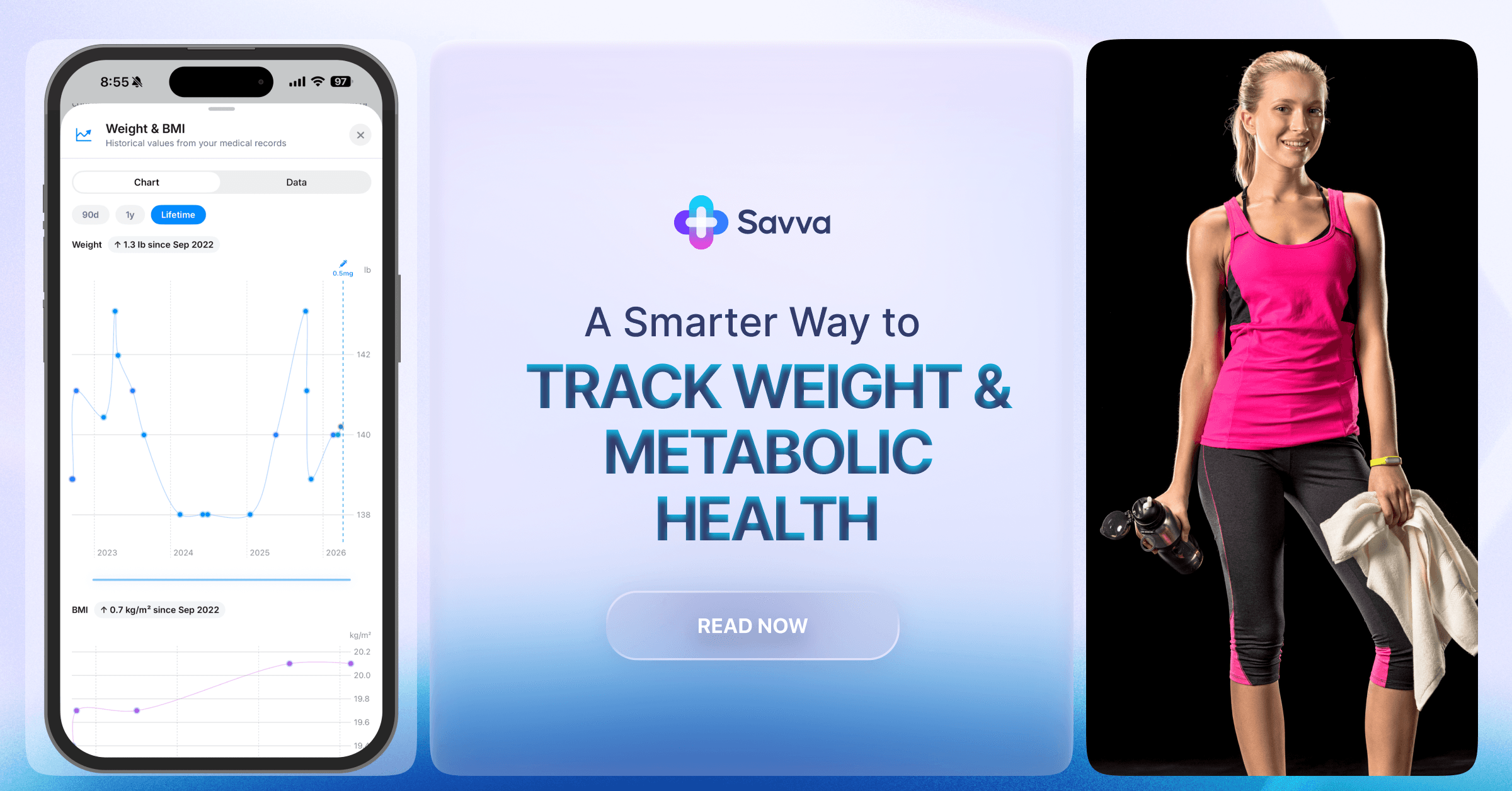
Savva pairs Weight and BMI on a single card. Two charts stacked: weight in pounds, BMI in kg/m2. Both pull from your manual entries and your patient portal records together. The scale at home and the scale at the doctor's office, finally on the same line. For people on a GLP-1 medication, dose markers appear inline on the chart, so each escalation shows up next to the weight curve.
Lungs, from your watch to your record
SpO2 (oxygen saturation) and respiratory rate update passively while you wear the watch. The Lungs card brings these two readings together, where most apps treat them as separate.
The chart pairs them: SpO2 with a normal-range band, respiratory rate plotted as a continuous line. Across 90 days, the rare dips that would never stand out in a single reading become easy to spot. A quiet pattern in the data that a single reading would never reveal.
The targets you set yourself
Daily Goals lets you set your own thresholds for blood pressure, HbA1C, fasting glucose, and Glucose Time-in-Range. The app does not assign them. You and your doctor do.
Each biomarker carries its own target. Systolic BP under 120. HbA1C under 7%. Fasting glucose under 100. The defaults are aligned with the ADA Standards of Care 2026, with a "Learn more" link next to each. They are starting points, not prescriptions, and yours to adjust with the people who know your case.
What Savva does not do
Savva is not a diagnostic tool. It does not assign you targets, score your readings, or recommend medication changes. Some apps will tell you whether your blood pressure is high enough to worry about. Some assign a "metabolic health grade." Some will message your doctor on your behalf. Savva does none of that.
What Savva does is bring your readings together so the patterns are readable, the targets are yours to set, and your appointments start with the data already organized. The interpretation belongs to you and your doctor. The organization belongs to Savva.
For more on the broader thinking, see the rise of preventive care 2.0.
When the picture finally exists, your biomarkers stop being a stack of disconnected readings and start being a story. Your blood pressure next to your HbA1C. Your weight next to your dose schedule. Your SpO2 across the months you felt off and the months you felt fine.
Better data does not replace your doctor. It changes the conversation you have with them.
Savva is where your labs, your home readings, your wearable data, and your medical history meet. One app, on your phone, where the patterns finally stop hiding from you.
Your health. Finally understood.
FAQs
Q1. Which biomarkers does Savva track?
The Biomarkers screen surfaces Blood Pressure, HbA1C, Weight and BMI, Lungs (SpO2 and respiratory rate), and Glucose. Other lab markers from your record are visible in your medical records view.
Q2. Can I add readings manually?
Yes. Manual entry is supported for Blood Pressure (with the AHA protocol), Weight, Glucose with optional fasting time, and GLP-1 doses.
Q3. Where do the biomarker readings come from?
Four sources, all on the same chart: your healthcare provider records (EHR), your manual entries, your wearable (Apple Watch and others), and Savva itself.
Q4. Can I set my own targets?
Yes. Daily Goals supports targets for blood pressure, HbA1C, fasting glucose, and Glucose Time-in-Range. Each goal has a Learn more link to the standards behind the default.
Q5. Are my biomarkers private?
Yes. All your readings stay on your phone. The 13 AI models run locally on your device. No cloud. No third-party sharing. No advertising use. No account required.