
You uploaded your records. You asked your questions. You received a summary.
But what if a different AI would have organized the same record differently?
What if the first summary you received was only one way of looking at the same information?
One AI model is only one way to read the same record. When multiple AI systems review the same lab result, the number stays the same while the structure of the summary changes. One model may lead with long-term history. Another may lead with the most recent value. A third may place that value next to surrounding lifestyle data or earlier visits.
Why One Summary Is Not the Whole Picture
A cholesterol value of 132 mg/dL looks exact. A fasting glucose of 104 feels precise. Blood pressure of 132 over 84 appears definitive. And yet, those numbers don’t tell the whole story.
One AI may summarize LDL as a recent value. Another may highlight that it has been stable for five years. A third may place it next to triglyceride ratios and body mass index from the same period.
None of them are changing the source record. They are organizing different parts of the same information.
Where The Summary Can Change
AI systems are not identical. They are built differently, trained differently, and they structure responses differently.
For example:
- ChatGPT may present the information in a structured format.
- Grok may place more attention on longer-term context in the record.
- DeepSeek may highlight numerical patterns across the data.
- Claude may organize the summary comparatively.
- Gemini may place the record next to surrounding lifestyle context.
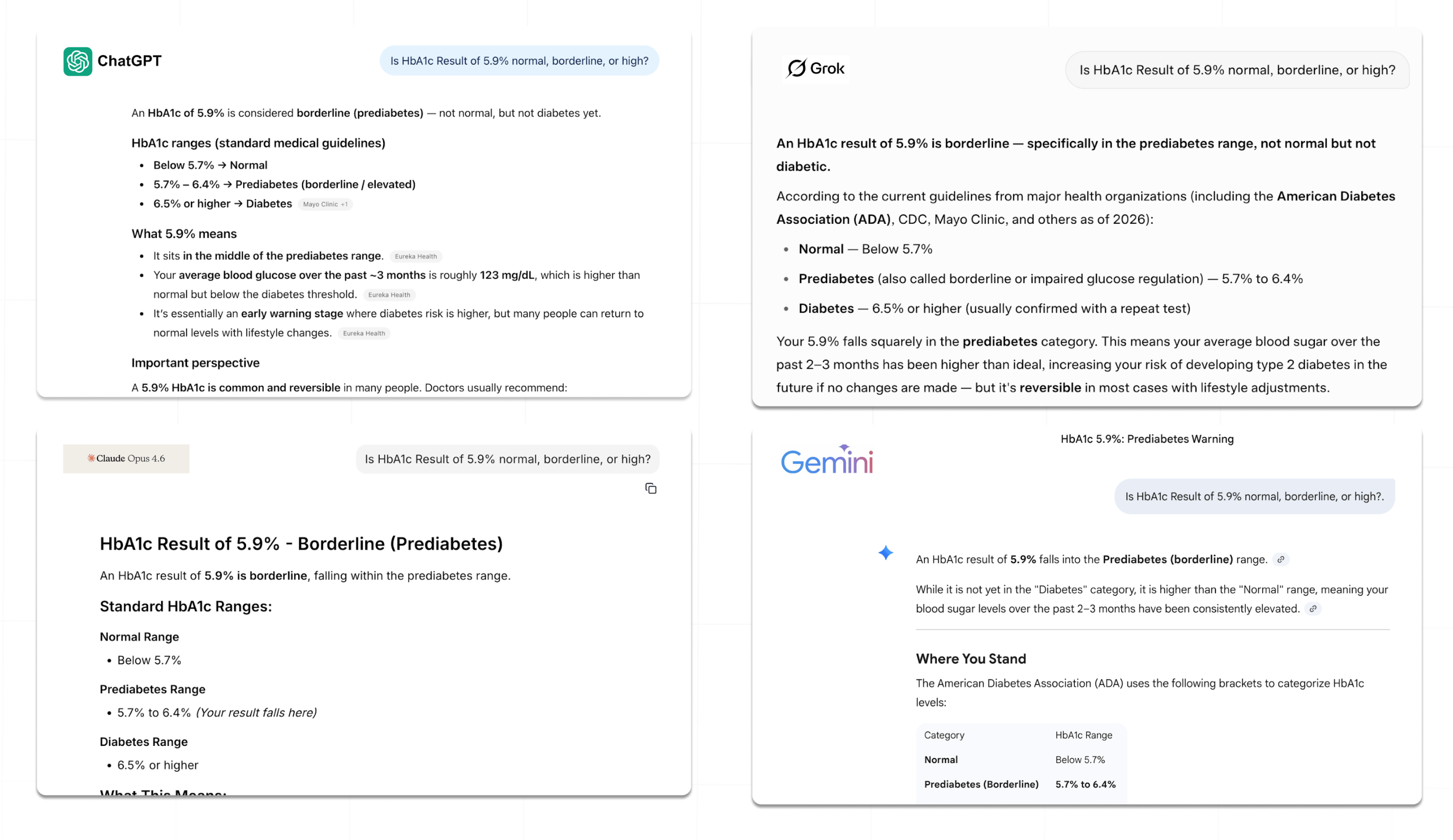
The same hemoglobin A1C value of 5.8 percent can be summarized as a recent reading, as part of a longer timeline, or alongside surrounding trends in activity or weight.
The number stays the same, but different models may organize the surrounding record differently.
The Problem With Trusting One Summary
Most people do not realize they are inside a single summary path. They ask a question, receive a response, and assume the first summary is complete. Then they ask a follow-up. And another. All inside the same model, the same framing, the same way of organizing the record.
It is not that the model is wrong. It is that every model has a different approach to what it surfaces first.
Healthcare data is not a simple document. It includes trends, timing, surrounding context, lifestyle patterns, and long-term history. No single model highlights everything equally. The first summary you receive shapes every question you ask after it.
That is the real limitation. Not accuracy. Framing.
When Comparison Creates Clarity
Now imagine placing two or three summaries side by side.
- One model says: “Here is the latest fasting glucose reading.”
- Another says: “Here is the six-year timeline for the same value.”
- A third adds: “Here are related numbers recorded during the same period.”
Instead of reacting to a single response, you begin comparing structure and context.
You ask better questions:
- Is this trending upward?
- Is this connected to sleep or activity?
- Has this pattern shifted over ten years?
- What else in the record happened around the same time?
Comparison changes the review process by adding context.
Multiple AI Models, One Continuous Record
For comparison to be meaningful, AI systems need context. They need more than a single PDF upload.
Savva allows users to search for and add healthcare providers they have seen over the years, even from different cities or states they have lived in. Whether those records are from five, ten, or twenty years ago, they can be brought into one continuous timeline.
That means when multiple AI models summarize your medical record, they are working from long-term history, not just one isolated visit.
You are not repeatedly uploading files but working from continuity.
If someone only has a physical document, it can still be uploaded or scanned securely. But the real strength comes from having years of connected records in one place.
Multi-Model AI Inside Savva
Savva provides two modes.
On-device AI runs directly on your phone. It keeps your data local and private. Nothing is stored externally. It provides summary-style responses using your connected record.
Cloud AI lets you compare how multiple AI models summarize your medical history side by side.
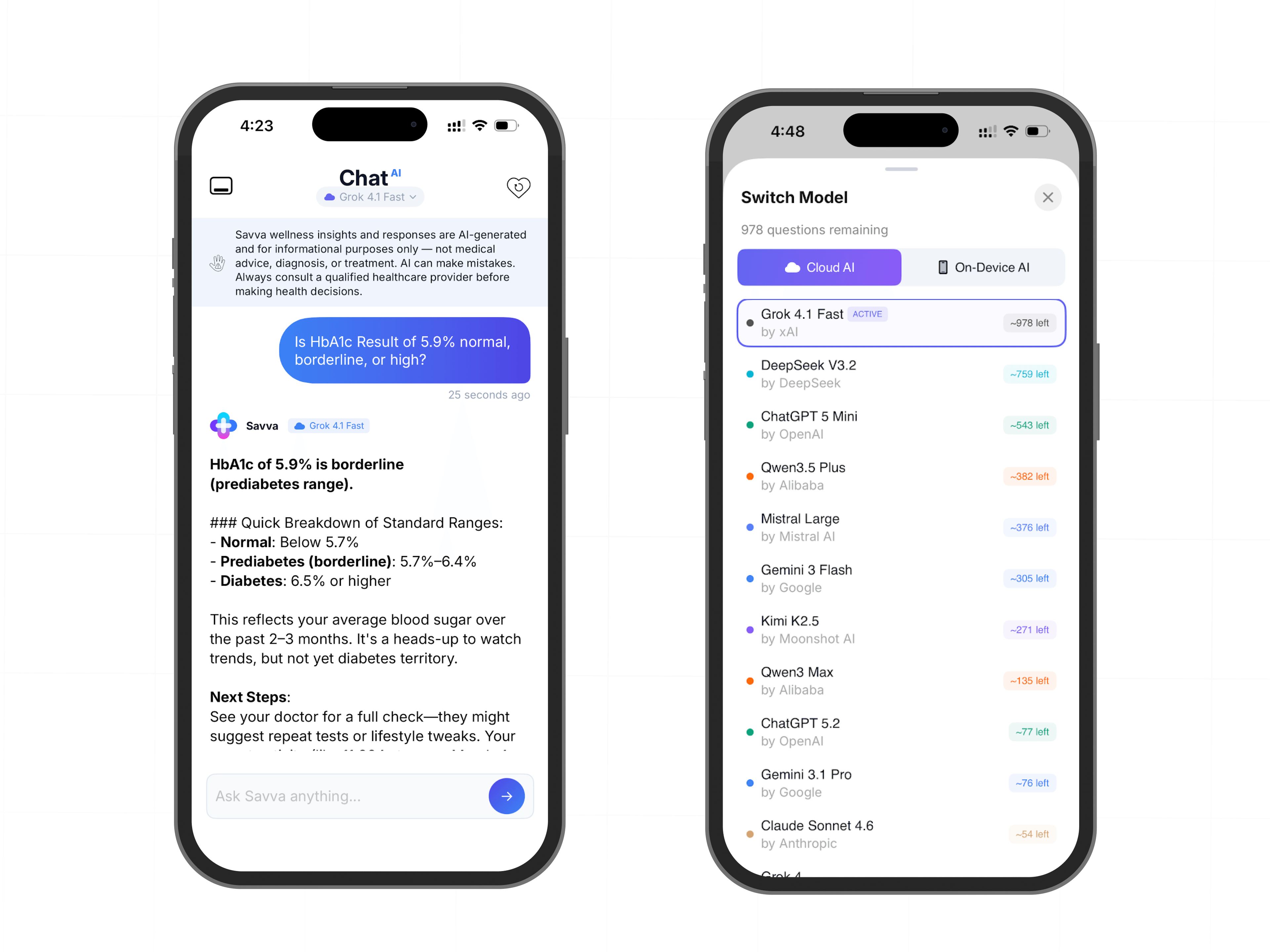
Inside Savva, you can see:
- Which models highlighted long-term trends
- Which emphasized stability over time
- Which connected lab values with surrounding lifestyle data
- Which focused on changes across the record
It is not about choosing a single “right” response. It is about reviewing how each model organizes the same data.
Why the Same Number Can Look Different Across Models
Two people can have the same fasting glucose reading. One has been walking 9,000 steps a day. The other has been averaging 4,500. One sleeps seven hours. The other averages five.
The number is identical. The surrounding record is not.
Some AI models surface lifestyle context alongside lab values. Others focus on the lab timeline alone. Neither is wrong. But if you only ever see one version, you are only ever seeing part of the record.
That is why the same number can feel alarming in one summary and unremarkable in another. The data did not change. The framing did.
Savva brings lab results, wearable data, and provider records together so each model is working from the same complete history, not just the most recent upload.
Beyond Certainty
Certainty feels reassuring, but it can narrow your thinking.
Seeing your medical record through multiple AI summaries does not have to create confusion. It can add depth by showing how different systems structure the same information.
Savva makes that broader view possible by bringing multiple AI models into one continuous history of your health.
Better context supports better questions. And better questions often start with seeing more than one summary.
FAQs
Q1. If AI models don’t always agree, does that make the summaries less useful?
Not necessarily. Different models can emphasize different parts of the same record, which can help show what deserves a closer look.
Q2. Why not just use one AI model instead of several?
No single model organizes every record the same way. Comparing multiple models helps show how emphasis changes across the same source information.
Q3. Could comparing multiple AI models create unnecessary confusion?
It can slow immediate reactions, but it can also make it easier to review the same record from several angles before drawing conclusions.
Q4. What if different AI models summarize the record in different ways?
That is expected. Different systems often organize the same information differently, which can help users review what each model is emphasizing.
Q5. Is this just the same summary rewritten in different wording?
No. Different AI systems are trained differently and weigh context differently, which can shift emphasis in meaningful ways.
Q6. Does comparing AI model summaries replace a healthcare provider?
No. Comparing summaries can help users prepare better questions, but it does not replace a healthcare provider.